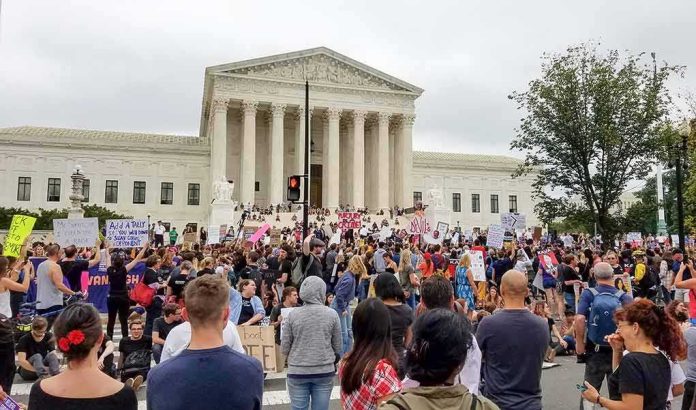
More than $1 million poured into a fundraiser for the accused mother’s parents as crowds in pink rallied outside the courthouse, exposing a raw national split over justice, mental health, and what our money says about our values.
Story Highlights
- Donors gave over $1,000,000 to support Lindsay Clancy’s parents during her murder trial.
- The fundraiser names her parents as beneficiaries and says funds are not for legal fees.
- Hundreds gathered in pink to back a mental-health message while critics objected.
- The case shows how crowdfunding turns private sympathy into a public moral fight.
What The Fundraiser Actually Supports
Campaign text states donations go to Mike and Paula Musgrove for travel, lodging, and living costs as they support their daughter during the case. A lawyer for Lindsay Clancy said the money is not for legal fees and has nothing to do with the defense. The organizer framed the appeal as family support, not a demand to endorse any view of the crime or the case. That clarity matters because people often assume online money covers lawyers.
News reports say the total passed $1,000,000 from more than 30,000 donors, with a goal set at $2,000,000. The scale drew attention well beyond Massachusetts. Many read the donations as a sign of sympathy for Clancy; others saw it as grace for her parents, who did not choose the alleged crime. Clear labeling reduced confusion about legal fees, but it did not end the debate over what the money represents in moral terms.
Why The Public Is So Divided
Prosecutors say Clancy killed her three young children in 2023; the defense argues she suffered postpartum psychosis and may not be criminally responsible. That clash set up a hard question: is this a crime to condemn or a tragedy to understand? Hundreds of supporters gathered outside the Plymouth courthouse wearing pink with messages like “She Needed Help,” pushing the mental-health lens into public view. Critics argue empathy risks softening justice for child victims.
Rally organizers and attendees said their goal was to raise awareness about postpartum depression, postpartum psychosis, and gaps in care, not to excuse violence. Supporters described Clancy as someone who sought help and did not get it. That lens speaks to many families who struggle to get timely care. Yet grieving communities and tough-on-crime voices see a bright line: children are dead, and justice must be firm. These values collide on the courthouse steps and in donor comment threads.
Crowdfunding Turns Private Sympathy Into Public Signals
Researchers call this a “tainted money” problem: support meant as kindness to a family can look like a reward tied to an alleged crime once it appears online at scale. Donation platforms make private aid visible, countable, and sharable. That invites people to read the act as a vote in a culture war, not only as charity. In past cases, fundraisers for defendants or their families sparked calls for removal, refunds, or new platform rules.
🇺🇸 The fundraising campaign for Lindsay Clancy's parents has reached over $1 million. Clancy is currently being tried for the murders of her three children in Massachusetts. GoFundMe, the site hosting the campaign, has banned the fundraisers for Kyle Rittenhouse and the Canadian…
— Hungarian Conservative (@hu_conservative) August 26, 2026
This case shows how the system leaves families to navigate long court fights and high costs. Governments talk about mental-health access, but care is scarce, slow, and expensive. When institutions fail, people turn to the internet for help. Donors step in, and anger follows. Both sides see proof the system favors the loud and the connected, not the vulnerable. That feeds the shared belief that the people in charge are not fixing the basics.
How To Read The $1 Million Without Losing The Plot
Two facts can be true at once. First, the money is for the parents’ expenses, not legal fees, as stated by the campaign and counsel. Second, the public sees the headline number and links it to a mother on trial for killing her children. The reaction is not just about this family. It is about trust in courts, access to care, and whether empathy and accountability can stand together. Until verdict and sentencing, these fights will stay loud, online, and unresolved.
Sources:
lifesitenews.com, washingtonexaminer.com, breitbart.com, yahoo.com, finance.yahoo.com, the-independent.com, abcnews.com, youtube.com, expertpages.com