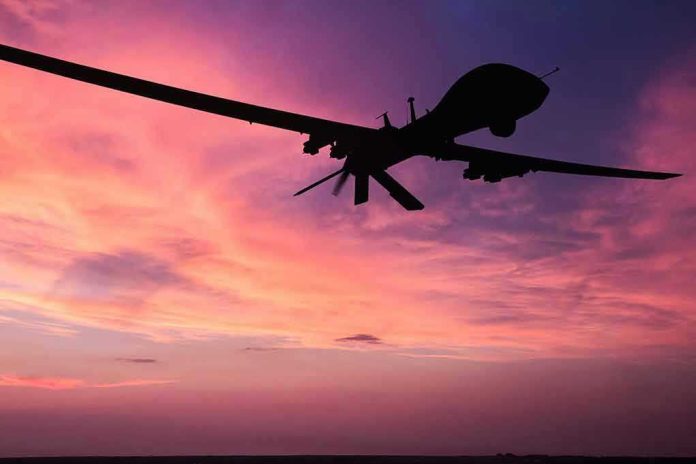
Cuba’s reported drone buildup is a sharp reminder that hostile regimes still sit just 90 miles from Florida.
Quick Take
- Axios says U.S. officials believe Cuba has obtained more than 300 military drones and discussed possible strikes on Guantanamo Bay, U.S. naval vessels, and Key West.
- The report relies on classified intelligence, not public documents, which leaves the key claims beyond independent verification.
- Officials quoted in the report called the situation an escalating danger, especially with Russian and Iranian links in the background.
- The same reporting says Cuba may have benefited from battlefield experience tied to Russia’s war in Ukraine.
What U.S. Officials Are Claiming
Axios reports that U.S. officials say Cuba has secured more than 300 military drones and has discussed using them against Guantanamo Bay, U.S. military vessels, and possibly Key West, Florida [1]. The story says the intelligence comes from classified material shared with Axios, which means the public is being asked to trust a serious national-security warning without seeing the underlying evidence. That matters when the alleged threat sits so close to American soil.
The report also says a senior U.S. official described the buildup as “an escalating danger” because of Cuba’s proximity and its connections to Russia and Iran [1]. For readers who remember years of weak border enforcement, open-ended foreign policy, and Washington acting surprised after the fact, the warning fits a larger pattern: adversaries probe where they think the United States will hesitate. The report frames Cuba as more than a nuisance and closer to a regional security problem.
Why The Allegations Are Being Taken Seriously
Axios says U.S. officials estimate that about 5,000 Cuban soldiers have participated in Russia’s invasion of Ukraine, and that some returned with knowledge of drone warfare [1]. The report also says Cuban authorities requested more drones and military equipment from Russia in the past month [1]. If accurate, that would suggest a regime learning from modern battlefield tactics rather than merely buying hardware for show. Still, the claims remain intelligence-based rather than publicly documented.
The same report says Cuban intelligence is trying to understand how Iran has resisted U.S. pressure, which would place Havana inside a broader network of anti-American military learning [1]. That is what should concern Americans most. Cheap drones have changed warfare, and hostile governments no longer need a major air force to create serious problems. They need access, training, and enough political will to gamble that the United States will not respond decisively.
What Is Known, And What Is Not
Multiple outlets repeated the core claim that Cuba acquired more than 300 drones, but the public record still lacks direct proof such as delivery manifests, satellite imagery, serial numbers, or procurement papers [2][3]. The report also does not identify the drone models, payloads, or ranges. That leaves an important gap between a serious allegation and a fully verified military assessment. Without those details, readers should treat the story as a warning, not a proven attack plan.
Axios is quoting US officials as saying that “Cuba has been acquiring attack drones of ‘varying capabilities’ from Russia and Iran since 2023, and has stashed them in strategic locations across the island” https://t.co/FNF14Uhxu5
— Anna Ahronheim (@AAhronheim) May 17, 2026
Axios also notes that a Cuban representative could not be reached for comment, so the first wave of coverage is one-sided [1]. That does not make the allegations false, but it does mean the public has not heard a direct rebuttal from Havana. For conservatives who value sober security policy, the right approach is clear: take the threat seriously, demand proof, and avoid the soft-on-adversary habits that have gotten the country into trouble before.
Sources:
[1] Web – Exclusive: U.S. eyes attack-drone threat from Cuba – Axios
[2] Web – US examining threat from Cuba, which has acquired over 300 drones
[3] Web – CUBA HAS ACQUIRED MORE THAN 300 MILITARY DRONES …