
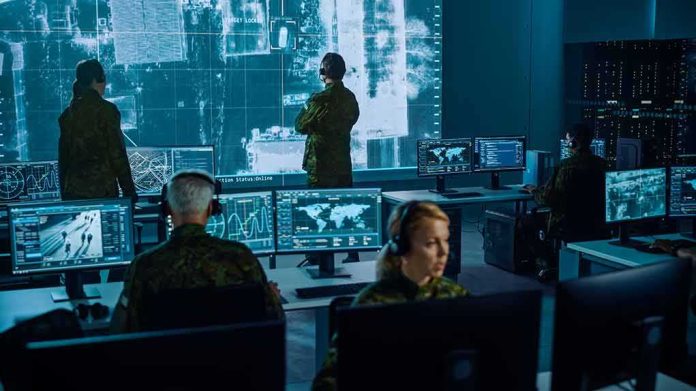
A billion‑dollar World Cup security dragnet is coming to America’s cities, and it will follow you from the airport line to the stadium drone shield.
Story Snapshot
- White House leaders call 2026 World Cup security the largest “whole-of-government” sports operation in U.S. history, backed by over $1 billion in funding.
- Federal agencies are rolling out new counter‑drone tech, no‑fly zones, and National Guard support around all U.S. match sites.
- Fans will face airport‑style screening, tighter stadium perimeters, and “no drone zones” at venues and fan festivals.
- Human‑rights groups warn these powers could super‑charge surveillance, immigration enforcement, and protest crackdowns if guardrails are weak.
Massive Security Machine Follows Fans From Airport To Stadium
White House task force officials say the 2026 World Cup will be the biggest security operation ever for a sporting event on U.S. soil, with more than $1 billion aimed at keeping stadiums and cities safe.[1][3] Reports say over $625 million is flowing through a special World Cup grant program, plus hundreds of millions more to fight unlawful drones and harden airspace.[1][5] Officials expect between 5 and 7 million foreign visitors, so the security footprint will touch airports, transit, and local streets in every host city.[1][3][5]
Airport travel is getting a major World Cup overhaul. The administration is promising upgraded screening lanes, automated eGate identity checks, and “one‑stop” connections for international flyers.[1][3][5] The goal, they say, is to move huge crowds faster while still catching threats. That means more cameras, more data checks, and more chances for federal agents to flag travelers for extra screening. For older Americans who remember post‑9/11 creep, this feels like another ratchet toward a permanent security state, even at a soccer game.[2]
Drones, Grants, And A New Counter‑Airspace Arsenal
Security planners say drones are the single biggest new threat facing the 2026 tournament.[4][7] Federal Emergency Management Agency grants and Pentagon funds are pouring into counter‑drone systems for the 11 U.S. host states, including radar networks, tracking software, and intercept drones that fire nets to capture hostile aircraft.[1][5] Officials have invested at least $115 million in Department of Homeland Security counter‑drone tech tied directly to the World Cup, on top of a $500 million national grant program that carves out special money for host cities.[1][5][6]
The Federal Bureau of Investigation created a National Counter Unmanned Aircraft Systems Training Center in Huntsville, Alabama, where more than 60 state and local officers have trained on drone‑mitigation tools.[4][6] In one publicly shown drill, agents detected a drone near a stadium, identified its operator, and sent an electronic command telling the pilot to land the aircraft immediately.[6] Temporary flight restrictions will make stadiums, practice fields, and fan zones “no drone zones,” with airspace rules similar to the Super Bowl.[6][7] That is meant to stop terrorists, but it also raises questions about how far federal power reaches over private hobby flyers and news crews.[3]
Stadium Perimeters Start To Look Like A Super Bowl — Or A Green Zone
Inside host cities, the plan is clear: turn every stadium into a layered security bubble. Officials say perimeters will be redesigned using the Super Bowl model, with multiple ticket checks, hardened outer fences, and separate fan zones for people without game tickets.[1][3][5][7] World Cup matches are tagged as “major special events,” which means a heavy mix of federal, state, and local police, plus National Guard units, all operating under a joint command structure.[2][4] Fans will feel that presence from the train platform to the turnstile.
Supporters of the plan say this is exactly how you protect a 104‑match, 48‑team tournament spread across three countries in a dangerous world.[2][6] They note that drones can carry explosives, disrupt games, or spy on teams, and that past races and events in the U.S. have already seen unauthorized aircraft enter restricted airspace.[3][6] A United Nations guide on major sporting events urges a “layered” approach with robust drills and worst‑case planning, which is what Washington says it is following.[6] Still, officials have not released detailed risk assessments or cost‑benefit studies that show these exact measures are needed at this scale.[1][2]
Rights Groups See A World Cup As A Test Bed For Surveillance
More than 120 civil‑society groups have warned that World Cup security could become a tool for immigration crackdowns, device searches, and social‑media screening of visitors. Amnesty International says the 2026 tournament risks becoming a “stage for repression,” pointing to fears of racial profiling, protest limits, and heavy surveillance around stadiums and fan zones. Human Rights Watch notes that only some host cities have real human‑rights plans, and even fewer have clear rules to stop abusive policing or arbitrary detention of fans and residents.
🇮🇱 The First Order Consequence:
– U. S. political and military processes are moving toward deeper operational alignment with Israel, including claims that U. S. planners have drafted (then repeatedly shelved) plans tied to capturing Iran’s Kharg Island
– That increases the… https://t.co/q9paKh5Qyz— U.S.A.I. 🇺🇸 (@researchUSAI) June 11, 2026
These warnings connect to a broader pattern inside the United States. Legal scholars and watchdogs have shown how new tools like facial recognition, drones, cell‑tower data “dumps,” and social‑media monitoring can chill speech and track protesters far beyond any one event. After years of revelations about secret phone‑record programs and bulk internet data collection, many Americans are wary when Washington says, “Trust us, this time is different.” Yet the same agencies that built past surveillance programs are now in charge of the World Cup’s cameras, scanners, and airspace controls.
What Conservatives Should Watch As The Tournament Nears
For constitutional conservatives, the World Cup is not just about soccer. It is a live stress test for how far federal security powers can stretch into daily life when officials invoke a global event. On one side, the Trump White House is right to treat terrorism and drone strikes as serious threats and to demand competence from agencies that failed under past administrations.[2][3][4] On the other side, there is still no public, venue‑by‑venue plan that spells out data‑retention limits, protest rules, or clear red lines on immigration enforcement near stadiums.
Human‑rights handbooks from the United Nations stress that major sporting events must follow a strict “do no harm” and human‑rights‑first approach. That means any new tech or authority should be narrowly tailored, transparent, and subject to real oversight. As drones, AI cameras, and joint command centers roll into American cities this summer, citizens and local lawmakers should insist on written guardrails, sunset dates, and independent reviews after the final whistle. That is how you keep fans safe without letting a month‑long tournament reset the balance between liberty and security for years to come.
Sources:
[1] YouTube – US ramps up 2026 FIFA World Cup security with counter-drone tech, …
[2] Web – US Pledges’ Safe, Welcoming FIFA World Cup In 2026
[3] Web – The World Cup poses an unprecedented security challenge at a fraught …
[4] Web – White House Details 2026 FIFA World Cup Safety and Hospitality …
[5] Web – US prepares massive security operation for 2026 World Cup, DHS …
[6] Web – US Promises ‘Safe, Welcoming, and Memorable’ FIFA World Cup in …
[7] YouTube – Counter-Drones & Tactical Escorts: Inside the Massive World Cup 2026 …