
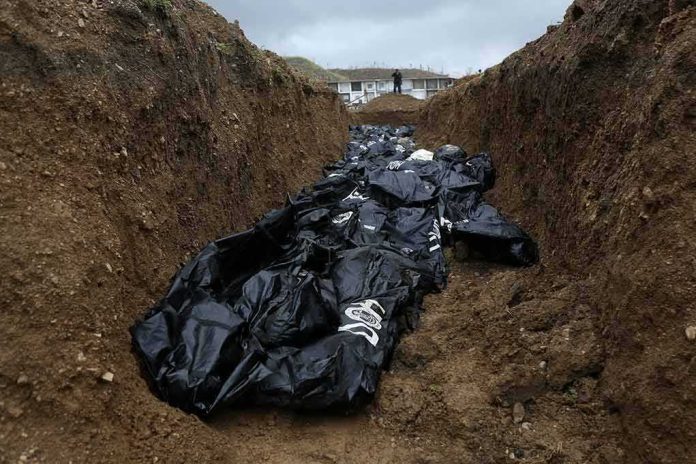
Nepal has started burying unidentified flood victims after collecting DNA, as the official death toll surged and thousands remain missing.
Story Snapshot
- Authorities reported hundreds dead and more than two thousand missing after the floods.
- Officials began temporary burials with DNA sampling to allow later identification.
- Chitwan district selected Devghat for burials and logged precise grave locations.
- Limited morgue capacity and health risks drove the burial decision.
Rising Toll And A Race Against Time
Nepal’s disaster count rose sharply over days, reflecting the scale of damage and the pace of recovery. Reports on August 30 said the toll neared 800, with about 2,500 people still missing after flash floods linked to a Himalayan glacier event. Police reported 469 dead by August 28, up from 95 reported on August 26, showing how fast the numbers changed as rescues and searches advanced. Families continue to wait for news as crews dig through mud and debris.
Rescuers, local police, and volunteers are working in river valleys and landslide zones. Officials warned that many areas remain hard to reach because bridges washed out and roads collapsed. Helicopters and boats shuttle supplies and teams when weather allows. Search teams mark recovery sites and move remains to district centers. Heavy rain, unstable slopes, and swift water slow progress. The window to find survivors narrows by the day, pushing leaders to add more personnel and gear.
Why Temporary Burials Began
Authorities started temporary burials because morgues filled up and bodies began to decompose in the heat. Officials said the goal was to protect public health while preserving a path to later identification. Nepal is collecting DNA from each unidentified body before burial. Crews assign unique numbers, tag remains, and log recovery details. This follows widely used disaster victim identification practices that store genetic profiles for later matches with family samples.
In Chitwan district, the District Security Committee chose an open site in Devghat for the burials. Officials recorded grave locations and used markers above and below ground. They also kept precise location data to allow exhumation when identities are confirmed. Local reports described coordinated work by police, district officers, and forensic staff. The process aims to balance faith traditions with urgent health needs until families can claim their loved ones.
Capacity Limits And Health Risks
Field reports from Chitwan described more than 200 bodies recovered while the local morgue could hold only about 50. After four days, decomposition made storage unsafe, and officials decided to proceed with burials. Reuters-style reporting cited statements that the district had no other option once conditions worsened. The plan included burying dozens of bodies on Saturday and over a hundred more on Sunday, with logs kept for each grave to support future exhumation and return.
Chitwan’s Devghat forest is being used for mass burials after the August 26 flash floods in Nepal. Authorities have buried 96 unidentified bodies and are collecting DNA samples to help families identify victims later.
VOICEOVER: Suha Nisviya S A
PRODUCER: Lavanya R
VIDEO… pic.twitter.com/mdctZGRgl3— The Federal (@TheFederal_News) August 31, 2026
International standards say bodies should be labeled, tracked, and stored when possible, but they also recognize that refrigeration and transport often break down in disasters. In those cases, documented temporary burial is an accepted step to protect communities while keeping the door open to later identification. Using DNA, unique identifiers, and mapped graves helps families find answers when systems stabilize and labs can process samples and matches.
What This Means For Families And Accountability
These steps matter because they protect dignity and truth. Each tag, sample, and map point makes it more likely that a mother, father, or child will be named and returned home. For families, a confirmed identity is the start of grief and closure. For officials, careful records support lawful exhumation and transfer later. The evolving toll highlights a common challenge in big disasters: counts change as crews reach new areas and as reports are confirmed, not because facts are hidden.
Authorities also face pressure to respect religious customs and local practices while managing public health. Careful documentation and the choice of a known site like Devghat are part of that effort. The district plan signals that burials are not the end of the process but a bridge to later identification and return. As more samples are analyzed and more families submit information, matches can bring people home and help the country measure the true human cost.
Sources:
youtube.com, khaleejtimes.com, thejournal.ie, english.news.cn, humanitarianlibrary.org