
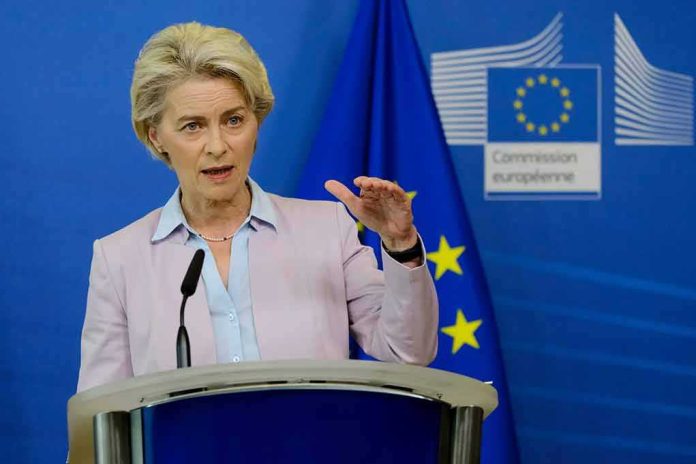
The European Union moved to lock in a trade deal with the United States just before President Donald Trump’s deadline, but the fine print still shows how shaky this “deal” really is.
Quick Take
- European Union member states gave final approval on June 25, clearing the way for the agreement to take effect before the July 4 deadline.
- The deal keeps a 15% tariff on most European exports to the United States and removes tariffs on U.S. industrial goods entering the European Union.
- The agreement is still political in nature, with safeguards, an end-2029 sunset, and questions about long-term stability.
- The Trump administration had warned of “much higher” tariffs if the European Union failed to move fast enough.
Approval Before the Deadline
European Union governments gave final approval on June 25 to the tariff deal struck with Washington in July 2025, putting it on track to take effect before Trump’s July 4 deadline.[1] The move closes a long stretch of delay that had frustrated U.S. officials and kept markets guessing. For American workers and businesses, the vote matters because it finally turns a political promise into something enforceable on paper.
Under the agreement, the United States keeps a 15% tariff on most European exports, while the European Union removes tariffs on U.S. industrial goods.[1][6] The White House also said the European Union will eliminate tariffs on all U.S. industrial goods and grant better access for some farm and seafood products.[6] That gives American producers broader access to Europe, even as the tariff terms remain lopsided in favor of the U.S. side.
What the Deal Actually Covers
The White House said the framework also includes a 15% ceiling on many European exports such as cars, semiconductors, and pharmaceuticals, along with a promise from the European Union to buy large amounts of U.S. energy and invest in the United States.[6] The White House fact sheet put those commitments at $750 billion in U.S. energy purchases and $600 billion in new investment by 2028.[6] Those numbers show the scale of the concession Europe made to avoid a deeper trade fight.
Still, the deal is not a clean, fully binding free-trade pact. European Union officials have described it as a political agreement, and the European Parliament added an expiration date at the end of 2029 unless it is renewed.[1][5] The European Union also kept a safeguard that allows it to suspend benefits if Washington fails to follow through.[5] That means the deal creates breathing room, but not a permanent truce.
Why Conservatives Should Watch Closely
Trump used tariff pressure to force movement, and that tactic appears to have worked again. European officials moved only after months of delay and clear warnings that the United States could raise duties even higher.[3][4] Supporters of hardball trade policy will see this as proof that leverage matters. Critics, however, will note that the arrangement still leaves major sectors exposed and depends on both sides honoring promises.
🚨 BREAKING: EU JUST APPROVED THE MAJOR US TRADE DEAL RIGHT BEFORE TRUMP’S JULY 4 DEADLINE! 🇪🇺🇺🇸
PARLIAMENT VOTED 440-151 TO CUT TARIFFS ON AMERICAN GOODS AND AVERT A TARIFF WAR. MEMBER STATES SET TO FINALIZE SOON. DEAL FROM LAST YEAR IS NOW MOVING FORWARD! pic.twitter.com/K9Z1dOvj8k
— Catie Bristow (@Catiebristow_X) June 25, 2026
The broader lesson is simple: trade peace is fragile when governments rely on political deals instead of firm law. The European Commission says the relationship between the two economies is the world’s largest bilateral trade and investment link, which makes stable rules especially important.[7] The United States Trade Representative says trade in goods and services with the European Union totaled an estimated $1.5 trillion in 2024.[8] When that much money is at stake, delay and uncertainty hit real businesses fast.
Sources:
[1] Web – EU-US trade deal to take effect before Trump deadline
[3] Web – EU lawmakers approve US trade deal to avert tariff conflict – Reuters
[4] Web – Fact Sheet: The United States and European Union Reach Massive …
[5] Web – EU and US agree trade deal, with 15% tariffs for European exports …
[6] YouTube – U.S., EU agree to trade deal framework that puts 15% tariffs on …
[7] Web – Agreement on Reciprocal, Fair, and Balanced Trade – Wikipedia
[8] Web – European Union | United States Trade Representative