
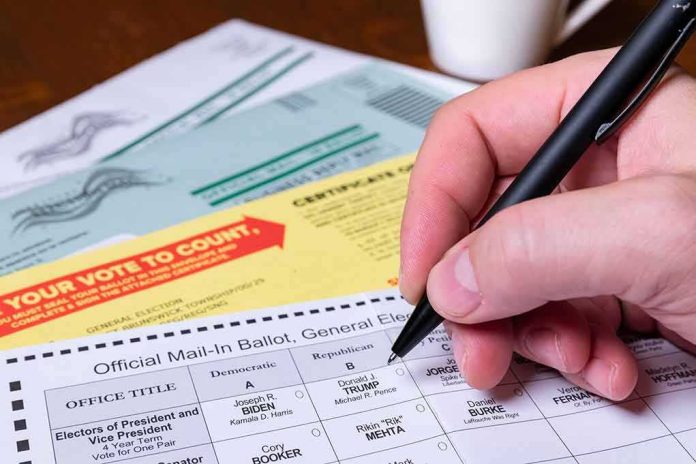
Contests over election mechanics often masquerade as breaking news; the durable question beneath them is simpler and harder: how should the law reconcile the voter’s right to a clear choice with a candidate’s right to appear on the ballot when two names are nearly identical and the outcome could hinge on confusion rather than conviction?
At a Glance
- The Justice Department sued to block Alaska from certifying its U.S. Senate race if incumbent Dan S. Sullivan loses, arguing a similarly named candidate could misdirect votes.
- Alaska courts kept Daniel J. Sullivan Jr. on the ballot and state officials labeled the two candidates differently, including an “incumbent” tag for the sitting senator.
- The DOJ’s theory rests on predicted voter confusion; critics call the case thin on evidence and note ranked-choice voting can blunt misfire effects.
- The dispute spotlights a recurring tension in election law: access to the ballot versus preserving a faithful expression of voter intent.
What the Alaska fight is actually about: voter intent versus ballot access
The core legal conflict is not exotic. When two candidates share a near-identical name for the same office, the law must decide whether the risk of misdirected votes justifies pre- or post-election intervention. The Department of Justice asserted that Alaska’s ballot—with both Dan S. Sullivan, the Republican incumbent, and Daniel J. Sullivan Jr., a retired teacher—creates a meaningful risk that supporters of the incumbent will accidentally select the other Sullivan, distorting the ranked-choice tally and potentially the victor. The requested remedy is extraordinary: withhold certification if the incumbent loses and conduct a post-election investigation into whether ballots for Daniel J. Sullivan were intended for Dan S. Sullivan.
This is not, at bottom, a fight over whether two people may lawfully share a name. It is a fight over whether the state must delay formal results to probe voter intent in the absence of individualized evidence of confusion. That is a high bar, by design; certification timelines exist to end elections, not to extend them indefinitely absent a concrete showing.
What Alaska already did to mitigate confusion
Alaska’s election officials did not ignore the problem. They differentiated the candidates on the ballot: “Dan S. Sullivan” appears as a registered Republican and “Incumbent,” while “Daniel J. Sullivan Jr.” appears without a party label. Those labels do real work for voters—party, incumbency, and a distinct middle initial are potent cues that reduce misattribution. Alaska’s courts also allowed Daniel J. Sullivan to remain on the ballot after earlier challenges, effectively holding that similarity alone is not grounds for exclusion when the ballot can clearly distinguish candidates. In other words, the state chose the traditional remedy: inform the voter at the decision point, rather than remove an otherwise eligible candidate preemptively.
Alaska’s ranked-choice voting (RCV) structure further complicates the DOJ’s harm theory. In RCV, voters can rank multiple candidates in order of preference; if they mistakenly rank the “wrong” Sullivan first, they can still rank the incumbent second, allowing their support to transfer if the first selection is eliminated. Analysts who view the DOJ’s claim skeptically argue that RCV can mitigate, not magnify, confusion-driven spoilage by preserving second-choice information. That does not eliminate the possibility of confusion entirely, but it narrows the pathway by which confusion could change the final outcome.
The DOJ’s theory of harm—and why it is controversial
The department’s complaint leans on a straightforward proposition: name similarity can siphon votes, and even a small number can matter in a close RCV environment. The filing posits a concrete mechanism—some supporters of Senator Sullivan will inadvertently vote for Daniel J. Sullivan—and seeks a certification injunction if the incumbent loses while the state investigates misdirected ballots. The premise is not fanciful; ballot design research and comparative election law recognize confusion as a real risk category. Yet the lawsuit attracts criticism on two fronts: timing and proof. Critics argue federal courts are reluctant to intervene in state certification absent a clear federal violation, and the DOJ advanced no empirical showing—surveys, incident reports, anomalous error patterns—demonstrating confusion was likely to a degree that would change the result.
That evidentiary gap matters. Courts often distinguish theoretical vulnerabilities from outcome-determinative defects. Alaska’s countermeasures—middle initials, incumbency labeling, party identification asymmetry—are the sort of practical steps jurisdictions use to keep the ballot open while clarifying choice. Without stronger proof that those steps failed or would predictably fail at scale, courts may see the federal request to delay certification as disproportionate to the demonstrated risk.
How we got here: earlier state actions and judicial rulings
Before the DOJ stepped in, Alaska’s Division of Elections tried to remove Daniel J. Sullivan, citing a lack of good faith and potential to confuse; a trial court and then the Alaska Supreme Court ordered him back on the ballot. The through-line is instructive: state administrators flagged confusion risk; state courts said the remedy is better ballot information, not candidate removal. When the DOJ later sought a federal certification pause if the incumbent loses, it essentially asked a federal court to revisit the confusion problem from the certification end of the process rather than the ballot-access end. That posture—federal scrutiny post-vote rather than state curation pre-vote—helps explain the backlash from election-law scholars who see federal intervention here as both late and legally tenuous.
Media accounts also reported direct White House involvement: President Trump publicly took ownership of ordering the suit, which sharpened the perception that this was not a neutral, rules-forward intervention but a partisan safeguard tied to a specific losing scenario. While presidential direction does not resolve the legal merits, it adds political heat to a case that already asks a court to privilege hypothetical confusion over a completed, labeled ballot approved by state courts.
🚨 ALASKA SENATE SHOWDOWN!
The DOJ is fighting to block certification of a narrow defeat for Republican Sen. Dan S. Sullivan, warning that a second candidate with nearly the SAME NAME could confuse voters.
Two Dan Sullivans. One Senate seat. A major legal battle.
Is this voter…
— Xi Znping (@XiZnping) October 27, 2026
What ranked-choice voting does—and does not—solve
It is tempting to assume RCV makes the confusion problem disappear. It doesn’t. RCV can capture second preferences and thus recover some mistaken first-choice selections. But confusion can still matter at the margins: an erroneously high first-choice tally for a namesake could affect elimination order and the transfer dynamics that follow. The Alaska ballot’s labels reduce this risk; RCV cushions it further by letting a confused voter list both Sullivans in sequence. The combination is a credible mitigation package. The DOJ’s position, however, treats residual risk as unacceptable, warranting a certification hold if and only if the incumbent loses—a remedial asymmetry that weakens the appearance of neutral error correction.
The broader principle that will outlast this case
Same-name candidacies are uncommon but not unheard of; they test two constitutional instincts that American election administration tries to honor simultaneously. First, we do not gatekeep the ballot by subjective judgments about motive when the candidate otherwise meets statutory qualifications—a principle reflected in Alaska’s judicial rulings keeping Daniel J. Sullivan on the ballot. Second, we do not tolerate election designs that thwart voters from expressing their real choice; hence the emphasis on clear labels, party cues, and procedural avenues to detect and correct genuine error. The least distortive equilibrium—open ballots, clear labels, targeted post-election remedies only when confusion is proven at scale—remains the most durable path.
Applied to Alaska, the weight of the evidence favors the state’s mitigation strategy over a preemptive federal certification hold: the ballot distinguishes the candidates; RCV preserves fallback intent; state courts have already validated access while endorsing clarity steps; and the federal complaint offers prediction rather than proof. If confusion ultimately emerges as measurable and material, election law already provides tools—recounts, targeted contests, and judicial review—to address it. Those tools should be used when facts demand them, not held over certification as a conditional threat.
Sources:
cnbc.com, npr.org, washingtonexaminer.com, cbsnews.com, newsweek.com, alaskasnewssource.com, usatoday.com, electionlab.mit.edu