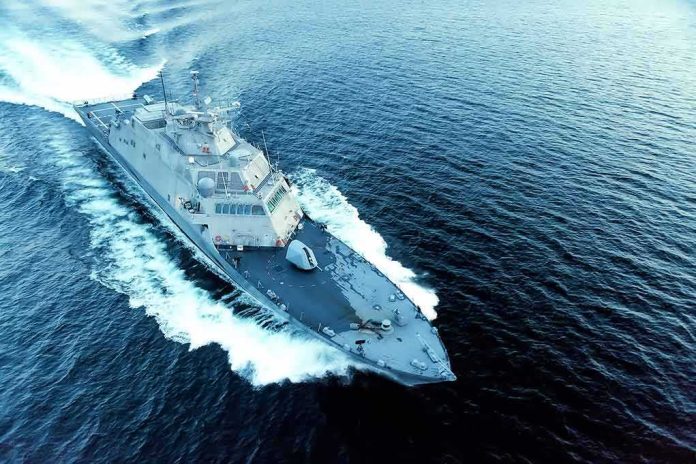
As Kim Jong Un puts a “nuclear-capable” 5,000‑ton destroyer to sea, America faces a growing rogue threat while our enemies test the resolve of the Trump administration and its allies.
Story Snapshot
- North Korea has commissioned the 5,000‑ton destroyer Choe Hyon, touting nuclear-capable missiles and expanded strike reach.
- Kim Jong Un says his navy’s nuclear armament program is “following its planned course unerringly,” and promises even larger 10,000‑ton warships.
- Analysts note there is still no independent proof of the ship’s nuclear weapons capability, calling key claims unverified.
- Kim personally supervised cruise missile tests from the destroyer, reinforcing a long pattern of provocative moves against the United States and its allies.
Kim’s New Destroyer: What Has Actually Been Put to Sea
North Korea has now placed the destroyer Choe Hyon, a roughly 5,000‑ton warship, into active service in the Korean People’s Navy. State media calls it one of the country’s largest and most advanced ships, with modern anti‑air and anti‑ship weapons and a bank of missile launchers meant for long‑range strikes. The ship reportedly carries ballistic and cruise missiles that Kim’s regime describes as able to carry nuclear warheads, raising alarms for American interests and regional allies in South Korea and Japan.Kim has framed the Choe Hyon as proof that his navy can reach far beyond coastal defense and threaten targets across wider waters.
Kim’s Claims of a Nuclear Navy and Bigger Warships Ahead
During the Choe Hyon commissioning ceremony at the port of Nampo, Kim Jong Un told his officers that equipping the North Korean navy with nuclear weapons is moving forward “unerringly” on its planned path. He declared that the era of a simple coastal defense fleet is “a thing of the past,” saying his navy is now a “full‑fledged service” with strategic tools for nuclear war. Kim also announced plans to follow this destroyer with the Kang Kon and then launch a series of 10,000‑ton “strategic warships,” each intended to expand preemptive strike options. These pledges fit a larger pattern of North Korean nuclear buildup that already includes land-based and sea-based missile programs.
Missile Tests, Nuclear Talk, and a Long Pattern of Provocation
Kim has not limited his nuclear talk to speeches; he has personally overseen missile tests from the Choe Hyon, including launches that state media described as nuclear-capable cruise missiles. North Korea recently boasted that these missiles flew complex paths over the sea and could hit targets more than 900 miles away while simulating nuclear detonations above their mark. This type of test is meant to show both range and warhead control, and it matches years of North Korean work on longer-range systems that can threaten U.S. bases in Guam and beyond. For American readers, this underscores how far North Korea’s missile technology has come, despite sanctions and U.N. pressure.
How Much of the Nuclear Claim Is Proven?
Even with this aggressive messaging, there is still a key gap: no outside expert has verified that the Choe Hyon’s missiles truly carry operational nuclear warheads. Analysts point out that North Korea routinely labels new systems “nuclear-capable” but refuses outside inspections or full technical data. That was true with earlier “nuclear attack” submarines and underwater drones, and it remains true with this destroyer. For now, the nuclear claims rest on North Korean state media and speeches, not on confirmed technical proof that the missiles on this ship are loaded with real, miniaturized nuclear warheads.
Russian Help, Modernization, and What It Means for the United States
Open-source experts who study imagery of North Korean naval projects note that many new systems, including those on vessels like the Choe Hyon, appear linked to Russian designs. Past analysis has pointed to foreign-sourced radar sets, air-defense weapons, and engines that help North Korea leap ahead faster than its own industry might allow. If Russia is helping Pyongyang build and arm large destroyers, that deepens the challenge facing the United States, which must now watch for combined threats from multiple hostile regimes. It also shows why strong American defense, energy independence, and secure borders matter when adversaries are joining hands overseas.
Why This Matters for American Security and Trump-Era Policy
For American conservatives, Kim’s new destroyer is not just a ship; it is another reminder that hostile states keep arming while many Western elites still push “globalist” deals and weak sanctions. North Korea’s move highlights the need for a firm Trump administration stance that backs U.S. allies but refuses blank checks or endless wars. It also shows why a strong Navy, sound budgets, and tough missile defenses are essential, especially when the same Washington crowd that failed to stop earlier nuclear tests now doubts the need for modern American weapons. Kim’s nuclear talk may be bluster, but ignoring it would be dangerous.
North Korea just commissioned the 5,000-ton Choe Hyon destroyer, armed with an 88-cell VLS capable of deploying sea-based nuclear missiles. With suspected Russian tech transfers, Pyongyang is actively shifting to a blue-water nuclear navy. 🚢🇰🇵 #Geopolitics #NavalDefense #DPRK pic.twitter.com/BOSsLVG5BL
— X News (@xnewsgusrix) June 26, 2026
Looking ahead, conservatives should watch three things: whether independent analysts can confirm any real nuclear load on the Choe Hyon’s missiles, whether Russia or other players deepen their support for North Korean naval projects, and whether the United States keeps investing in missile defense and Pacific alliances under Trump. The ship itself may be partly propaganda, but the threat behind it—North Korea’s proven nuclear tests and growing missile reach—is very real. A clear-eyed, America-first policy will have to treat this destroyer as one more warning shot in a dangerous world.
Sources:
en.wikipedia.org, beyondparallel.csis.org, youtube.com, facebook.com, news.usni.org, reddit.com, instagram.com, inkl.com