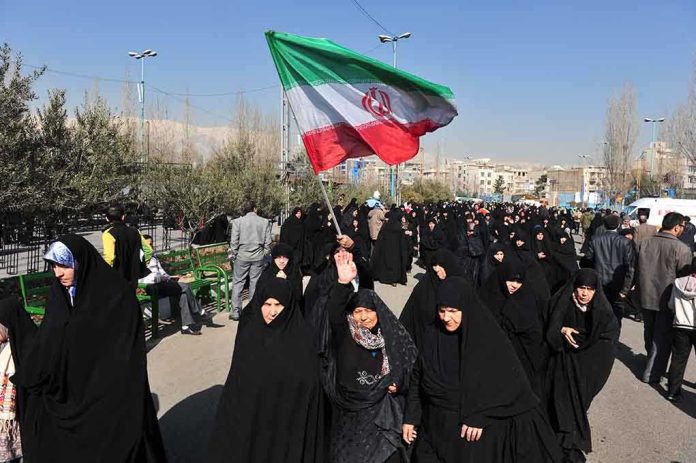
Iran’s regime faces its most existential domestic threat in years as protesters abandon traditional tactics for a guerrilla-style movement that’s proving nearly impossible to crush.
Story Highlights
- Protests evolved from economic grievances to explicit anti-regime uprising across 348 sites in 111 cities
- Demonstrators shifted to decentralized, mobile tactics including rooftop chanting and rapid flash gatherings
- At least 42 killed and over 2,270 detained as authorities cut internet and deploy overwhelming force
- Trump warns US is “locked and loaded” if Iran violently kills peaceful protesters
From Market Stalls to Revolution
What began December 28th as merchants closing shops over currency collapse has morphed into something far more dangerous for Iran’s theocratic rulers. The Iranian rial plummeted to 1.42 million per US dollar, triggering food price riots in Tehran’s Grand Bazaar that quickly spread beyond anyone’s control.
Within days, protesters weren’t just demanding economic relief. They were chanting “Death to Khamenei” and calling for the complete overthrow of the Islamic Republic. By January 8th, demonstrations had exploded to what analysts call the largest and most intense wave of the entire 2025-2026 cycle.
The Ghost Protest Strategy
Iranian protesters learned hard lessons from previous crackdowns. Instead of massing in predictable locations where security forces could surround them, they’ve adopted what amounts to urban guerrilla tactics. Short, mobile gatherings appear and dissolve before authorities arrive. University students coordinate simultaneous actions across 45 campuses.
Most ingeniously, protesters take to rooftops and windows at night, shouting anti-regime slogans from the safety of their homes. This “ghost protest” strategy forces the regime to choose between violating every home in Iran or tolerating organized dissent echoing through major cities after dark.
Regime’s Desperate Countermeasures
Supreme Leader Ali Khamenei’s response reveals the depth of his panic. On January 3rd, he declared that “rioters must be put in their place,” effectively green-lighting whatever force security commanders deemed necessary. Internet and international phone services were severed to prevent coordination and outside documentation of government brutality.
The regime’s playbook from 2019 and 2022 protests isn’t working this time. Central Bank Governor Mohammad Reza Farzin resigned amid the chaos, and even President Masoud Pezeshkian’s promises to fix economic problems ring hollow when security forces are firing live ammunition at citizens demanding basic dignity.
Iran Witnesses Biggest Protests So Far As Demonstrators Change Tactics https://t.co/aWp1CGRH07 Iran Protests Enter Twelfth Day as Deadly Crackdown, Internet Blackout, and Nationwide Strikes Intensify https://t.co/ZfCnVw7QCG
— 'ℳ' .。.:*・🦋®︎ (@Quincampoix_jp) January 9, 2026
International Stakes and Trump’s Warning
This isn’t just Iran’s internal affair anymore. President Trump issued a stark warning that if Iran “violently kills peaceful protesters,” America would “come to their rescue” and stands “locked and loaded and ready to go.” This followed recent U.S. strikes on Iranian nuclear facilities, raising the specter of broader regional conflict.
The timing couldn’t be worse for Tehran’s mullahs. With their economy in freefall, their population in open revolt, and American military pressure mounting, they’re discovering that four decades of authoritarian rule provides no roadmap for survival when legitimacy evaporates. The protesters’ tactical evolution suggests they’ve learned to sustain pressure indefinitely, turning Iran’s vast geography from the regime’s advantage into its nightmare.
Sources:
WTOP – A timeline of how the protests in Iran unfolded and grew
Wikipedia – 2025–2026 Iranian protests
National Council of Resistance of Iran – Iran news in brief January 7, 2026
Institute for the Study of War – Iran Update January 8, 2026
ABC News – Iran’s new wave of protests prompt hospital raids, internet shutdowns
Iran International – Iran coverage