The real story on the California–Mexico border is not the desert or the wall, but the quiet decision to turn more American land into a militarized zone in the name of security.
Story Snapshot
- The Trump administration directed a new militarized zone along the California–Mexico border as part of broader immigration enforcement.
- The move reflects a long trend of turning border management into a permanent security theater rather than a targeted law-enforcement tool.
- Border communities shoulder the daily impact, from property rights to local economies and civil liberties.
- Conservatives face a key question: how to defend sovereignty and law while resisting an ever-expanding federal security footprint at home.
A New Militarized Zone In A Long Border Story
The Trump administration added another militarized zone along California’s border with Mexico, framed by federal officials as a necessary step in a wider crackdown on unlawful migrant crossings. The Department of the Interior announced the move as part of a package of border security efforts meant to make illegal entries more difficult and more costly. The term “militarized zone” signals more than a fence; it signals a layered security posture that treats a slice of U.S. territory as a quasi-front line.
This shift did not happen overnight. Federal agencies have spent decades converting the southern border into a web of checkpoints, patrols, vehicle barriers, and surveillance towers. What once was largely a question of local law enforcement and customs has evolved toward a standing security architecture that looks and feels military, even when staffed by civilian agencies. The California segment, with its busy ports of entry and long stretches of rural land, now joins other sectors where physical presence, technology, and rapid-response forces define daily life.
Trump administration setting up another militarized zone on California-Mexico border https://t.co/5CcfC3xIK4
— Ryan Mancini (@ManciniRA) December 11, 2025
What “Militarized Zone” Really Means On The Ground
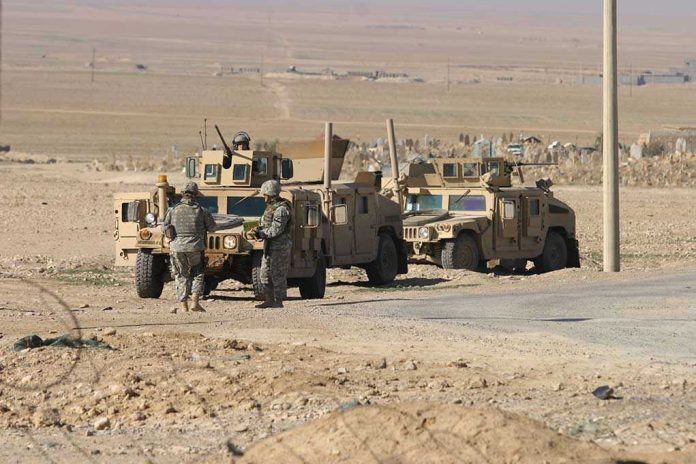
For border residents, a militarized zone is not a press release phrase; it is helicopters overhead, armored vehicles on dirt roads, and heavily armed agents in places where families shop and kids go to school. Federal authorities typically combine vehicle obstacles, restricted-access corridors, and advanced sensors to funnel crossings toward areas they can monitor and control. The strategy aims to deter large groups, smugglers, and repeat crossers by making the terrain less forgiving and the chances of detection far higher.
Property owners frequently find themselves caught between Washington’s plans and their own expectations of ordinary civil life. Expanding security zones can mean new easements, construction near homes, or increased traffic from patrols at all hours. Supporters argue that this is a reasonable tradeoff when facing cartels that treat the border as a revenue stream. Critics respond that constant militarized presence slowly normalizes a lower standard for privacy and property rights in entire regions of the country, far from any declared war zone.
Security, Sovereignty, And The Conservative Dilemma
American conservatives generally support strong borders, clear sovereignty, and serious consequences for unlawful entry. On those points, the Trump administration’s decision aligns with a long-standing view that a nation that cannot control its borders will eventually lose control over its laws and culture. A militarized zone promises visible enforcement: more boots, more barriers, and faster response when groups attempt to cross between official ports of entry. From that angle, the policy reflects a law-and-order instinct.
Yet a conservative reading of the Constitution also raises legitimate questions about how far federal power should extend into everyday life on American soil. When layers of militarized infrastructure expand, the federal government gains more tools to monitor, restrict movement, and exert force in areas where citizens live and work. Those tools might be justified against cartels and traffickers, but they do not vanish when the threat fades or the administration changes. Common sense suggests that any power built for one crisis can be repurposed during the next one.
Costs, Effectiveness, And The Risk Of Permanent Emergency
Supporters of the new California zone argue that strong physical and tactical measures save lives by deterring dangerous crossings in remote areas and disrupting smuggling routes. When people must go through official ports, authorities can screen for criminals, traffickers, and contraband instead of playing cat-and-mouse over miles of open terrain. That logic resonates with many voters who see chaos at the border as both a security risk and an affront to the basic principle that laws must mean what they say.
Opponents counter that militarization often shifts routes rather than eliminating them, while leaving a heavy footprint on communities that never voted to live in a security corridor. They warn that when Washington treats the border as a permanent emergency zone, it encourages a mindset where extraordinary measures become the new normal. From a conservative standpoint, that concern deserves serious weight: a government that gets comfortable militarizing one region may find it easier to deploy similar tools around critical infrastructure, protests, or urban hotspots under future pretexts.
What Comes Next For The California Border
The new militarized zone in California signals that debates over the southern border are far from resolved. Each additional layer of security hardens the line but also hardens the political stakes. Future administrations will face intense pressure either to maintain the infrastructure, expand it, or roll it back, and each choice will send a message about how the nation balances security with limited government. Voters in their 40s, 50s, and 60s will likely watch not just the numbers at the border, but the precedents quietly set at home.
Long term, the fight will not be over a single stretch of desert but over the principle of how a free republic handles real threats without training itself to live in a constant state of militarized exception. Supporters of firm borders and conservative values can back strong enforcement while still demanding strict limits, clear oversight, and sunset mechanisms on extraordinary measures. The California militarized zone shows how easily those lines can blur and how important it is to keep them sharp.
Sources:
Trump Administration Adds Militarized Zone in California Along Southern US Border