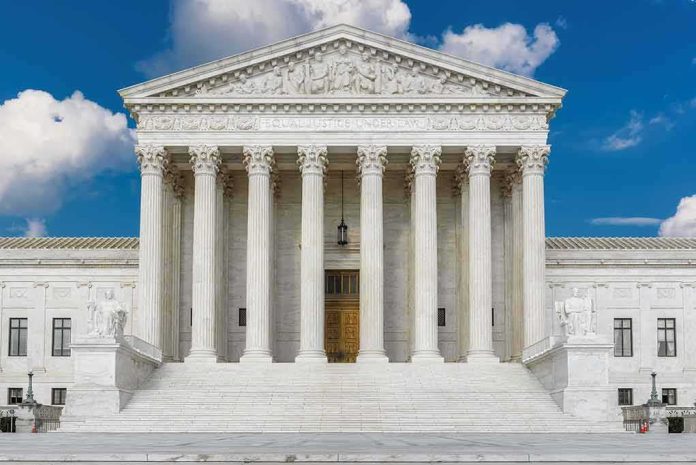
In a 5-4 decision, the Supreme Court just told President Trump — and the political class — that even in an age of executive power and deep‑state mistrust, the plain words of the Constitution still beat raw politics.
Story Snapshot
- The Supreme Court struck down Trump’s executive order to end birthright citizenship and reaffirmed that babies born on U.S. soil are citizens.
- A narrow 5-4 majority relied on the 14th Amendment and the 1898 Wong Kim Ark case, rejecting new limits based on parents’ immigration status.[4]
- The ruling blocks Trump’s order for now but leaves room for more fights in lower courts and in Congress over immigration and injunctions.[2]
- Reactions on the right and left show a deeper anger: many see a government serving elites and court politics, not ordinary Americans.
What The Court Actually Decided
The Supreme Court ruled that the 14th Amendment’s Citizenship Clause still means what it has meant for more than 125 years: if you are born on United States soil and are subject to United States law, you are an American citizen. The majority opinion leaned heavily on the 1898 case United States v. Wong Kim Ark, which held that a child born in San Francisco to Chinese immigrant parents was a citizen at birth despite their lack of citizenship. That old case has been the backbone for modern birthright citizenship. Trump’s order tried to carve out babies born to undocumented immigrants and many temporary workers, but the Court said an executive order cannot rewrite the Constitution.[2][4][6]
The justices also addressed Trump’s separate win on nationwide injunctions, where the Court had recently limited lower judges from blocking federal policies across the whole country. In this new ruling, the Court drew a sharp line: judges may be more cautious with broad injunctions, but they still must stop actions that plainly violate constitutional rights. That distinction matters because Trump’s team argued that even if his order raised hard questions, courts should not freeze it everywhere at once. The majority disagreed, saying citizenship is too basic to leave in limbo.[2]
The Battle Over “Subject To The Jurisdiction”
At the center of the case was one short phrase in the 14th Amendment: “subject to the jurisdiction thereof.” Trump’s solicitor general John Sauer argued that this language covers only children whose parents are lawfully settled here with a permanent home, not people he called “temporary visitors” or illegal border crossers. He pointed to older cases and post‑Civil War debates to claim the amendment was meant mainly for freed slaves and those clearly tied to the nation. A network of conservative lawyers and groups backed this view, saying modern courts have stretched the clause far beyond its original meaning.[2][10][21]
Most legal scholars and civil rights lawyers pushed back, saying that reading ignores a century of case law and common sense. Wong Kim Ark described birthright citizenship as an “ancient and fundamental” rule and listed only a few narrow exceptions, such as children of foreign diplomats or enemy armies on occupied land. Later decisions, including a 1982 case on the rights of undocumented children to attend public school, treated undocumented families as fully under United States law: they can be arrested, tried, and taxed like anyone else. For the majority, that reality made Sauer’s “no allegiance” argument hard to square with everyday life.[4][5][6]
Why This Feels Bigger Than One Immigration Fight
This ruling lands in a country already divided over immigration, welfare, and “America First” policies, but united in one belief: the federal government is failing ordinary people. Many conservatives see birthright citizenship as fueling illegal immigration and welfare fraud, pointing to stories from California about sham hospice patients and swollen benefits rolls. They argue that elites in both parties use cheap labor and loose borders while working families pay the price in lower wages, crowded schools, and higher taxes. For them, Trump’s order looked like a long‑delayed attempt to protect the nation’s resources.[1]
Many liberals, meanwhile, view the same order as an attack on a core promise of American life: that anyone born here starts on equal footing, no matter their parents’ status or wealth. They worry that carving millions of American‑born kids out of citizenship would create a permanent underclass with no vote and few rights. That fear ties into broader anger at rising inequality and the sense that the system favors corporations, lobbyists, and donors. Both sides, in different ways, see a government that talks about “the people” but mostly serves well‑connected insiders.[3]
Elites, Pressure, and The Court’s Fragile Legitimacy
Trump did not keep his opinions quiet as the case moved forward. He warned that upholding birthright citizenship would cost “massive amounts of money” and hurt national dignity, effectively telling the justices that a ruling against him would weaken the country. He reposted radio host Michael Savage’s claims that some conservative justices had “gone weak” and that civil rights lawyers were part of a criminal racket. Savage even labeled the American Civil Liberties Union “the most dangerous criminal organization in America” and called for it to be prosecuted under organized crime laws. These attacks fed the belief, common on both left and right, that legal fights are more about raw power than careful reading of the law.[1]
Today, the Supreme Court reaffirmed that nearly all people born on U.S. soil are American citizens.
Read a roundup of what Yale Law School faculty have said about the birthright citizenship case.https://t.co/8eeIMBDEjs pic.twitter.com/aMdn1T76bJ
— Yale Law School (@YaleLawSch) June 30, 2026
Yet the legal record undercuts some of the panic. Congress has copied the Citizenship Clause’s language into federal law more than once, without adding any carve‑outs for undocumented parents. Courts and officials have treated United States‑born children as citizens for generations, across parties and eras. One study from the American Immigration Council concluded that the only real way to end birthright citizenship would be a new constitutional amendment or a shocking break from settled precedent. That is a high bar, and the Court’s close vote shows five justices were not willing to cross it — even in a time when trust in institutions is thin, and both sides suspect that “deep‑state” forces are calling the shots.[2][5][7]
Sources:
[1] Web – Supreme Court Upholds Birthright Citizenship, Strikes Down Trump …
[2] Web – US Supreme Court appears sceptical of Trump plan to limit birthright …
[3] Web – Birthright Citizenship Under the U.S. Constitution
[4] Web – Supreme Court Arguments Wrap in Landmark Challenge to Trump …
[5] Web – Supreme Court Arguments Wrap in Landmark Challenge to Trump …
[6] Web – Supreme Court Expresses Skepticism at Trump’s Effort to Eliminate …
[7] Web – United States v. Wong Kim Ark – The National Constitution Center
[10] Web – Supreme Court’s decision on birthright citizenship will depend on its …
[21] Web – The Origins of Birthright Citizenship in the United States, Explained