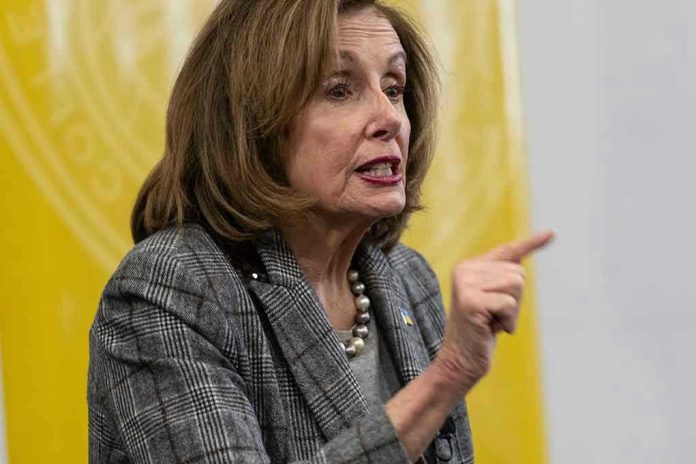
When Nancy Pelosi condemned the White House Correspondents’ Dinner shooting as a “terrifying act of violence,” critics immediately recalled her history of blaming inflammatory political rhetoric for attacks—raising questions about consistency when the target was her longtime adversary, Donald Trump.
Story Snapshot
- A shooting at the White House Correspondents’ Dinner on April 25, 2026, sent 2,000 guests into panic, though President Trump and attendees emerged unharmed.
- Former House Speaker Nancy Pelosi issued a statement condemning the violence and praising law enforcement, while referencing the 2022 hammer attack on her husband.
- Online critics pointed to perceived hypocrisy, contrasting her condemnation with past statements about dangerous political rhetoric from Democrats.
- Trump characterized the incident as the work of a “lone wolf,” framing political violence as a consequence of being impactful.
- The incident reignites debates over inflammatory language in politics and security protocols at high-profile events.
When Political Violence Hits Close to Home
The Washington Hilton became a scene of chaos late Saturday night when gunfire erupted during the annual White House Correspondents’ Dinner, a traditionally bipartisan journalism gala. Approximately 2,000 guests, including President Trump and First Lady, scrambled for cover as Secret Service and local law enforcement responded swiftly. An officer sustained injuries during the incident, though no VIPs were harmed. The event, which has taken place for decades without such disruption, marked a disturbing escalation in political violence at elite gatherings.
Pelosi issued her statement from San Francisco later that evening, expressing relief that Trump and attendees were safe while offering prayers for the injured officer. Her language was measured and nonpartisan, focusing on gratitude for law enforcement rather than political blame. Yet the statement carried personal weight. She explicitly referenced the October 2022 hammer attack on her husband Paul at their San Francisco home, an assault that left him severely injured and the perpetrator serving a life sentence. For the Pelosi family, political violence is not an abstract concept but a lived trauma.
The Rhetoric Boomerang
Critics wasted no time drawing connections between Pelosi’s current statement and her previous commentary on political rhetoric. Over recent years, particularly following the January 6 Capitol riot and the attack on her husband, Pelosi has been vocal about the dangers of inflammatory language from political figures. She has called out what she termed “unhinged” rhetoric that could inspire violence, holding leaders accountable for the consequences of their words. The irony observers noted was stark: when violence touched Trump, the condemnation came without accompanying criticism of the heated political discourse Democrats themselves have employed.
Trump’s own response to the shooting revealed his characteristic framing of victimhood through prominence. Calling the attacker a “lone wolf,” he suggested that political violence naturally follows impact. “When you’re impactful, they go after you,” he stated, positioning himself as a target of consequence rather than chance. This narrative conveniently sidesteps questions about whether his own rhetoric might contribute to a climate where violence becomes conceivable. Both principals, longtime adversaries, seemed to miss the larger point: condemning violence rings hollow when selectively applied based on partisan advantage.
The Consistency Question Conservatives Keep Asking
The flashbacks to Pelosi’s previous statements expose a legitimate concern about double standards in political discourse. When Paul Pelosi was attacked, Democrats broadly attributed the violence to right-wing extremism fueled by conspiracy theories and heated Republican rhetoric. The media coverage and political response emphasized systemic causes rather than individual pathology. Yet when a shooting disrupts an event attended by Trump, the initial framing gravitates toward the “lone wolf” explanation that minimizes broader context. This inconsistency feeds conservative skepticism about whether calls for toning down rhetoric are genuine principle or convenient weapon.
Common sense suggests that political violence should be condemned uniformly, regardless of the victim’s party affiliation or policy positions. The standard cannot shift based on whether the target aligns with one’s political preferences. Pelosi’s statement, while appropriately condemning the shooting, missed an opportunity to acknowledge this larger truth. Consistency matters in public trust. When prominent figures selectively apply their principles about dangerous rhetoric, they undermine their own credibility and deepen the partisan divide they claim to oppose. Americans across the political spectrum can recognize selective outrage when they see it.
Security and Symbolism at Stake
The shooting raises immediate practical concerns about security at political events. The White House Correspondents’ Dinner brings together journalists, politicians, celebrities, and the sitting president in a relatively open environment designed to celebrate press freedom. That openness now appears vulnerable. Event organizers and law enforcement will inevitably enhance protocols, potentially transforming the character of such gatherings. The journalism community, already navigating threats and declining public trust, faces fresh trauma that may reshape how media figures engage in public spaces.
Nancy Pelosi's Post About WHCD Shooting Sparks Flashbacks to What She Said About Unhinged Dem Rhetoric https://t.co/hRBn2OgOzb
— 🇺🇸Harry Hopkins✝️🐖 🍸🐕 (@harryh12801) April 27, 2026
Beyond logistics, the incident carries symbolic weight about America’s political culture. When even a dinner intended to unite press and politicians across party lines becomes a shooting scene, something fundamental has fractured. The rapid containment prevented catastrophe, but the near-miss reveals how close the nation stands to unthinkable violence at the highest levels. Pelosi’s invocation of her family’s experience acknowledges this reality. Yet acknowledgment without introspection about one’s own role in the broader climate accomplishes little. The country needs leaders willing to model the consistency they demand from others, condemning violence and inflammatory rhetoric uniformly rather than weaponizing both for partisan advantage.
Sources:
A Terrifying Act of Violence: Pelosi Reacts to Shooting at White House Press Corps Dinner
Pelosi Statement on Shooting at White House Correspondents’ Dinner